
Cultivar record / white-widow
White Widow
First created by Ingemar (also known by the seed bank name De Sjamaan) under the original name Arnhem's Wonder, this cross of a Brazilian sativa landrace and a resin-heavy South Indian indica won the first High Life Cup in 1989.
- Type
- hybrid
- THC
- 15%
- CBD
- <1%
- Breeder
- Green House Seeds
Archive photography
White Widow Strain Gallery
5 archive images. Select any image to view it full screen.
Archive descriptors
Record notes
Only descriptors supported by both the archive record and supplementary cultivar data are listed here.
Reported feelings
Flavour notes
Terpenes
Genetics
- Brazilian Sativa
- South Indian Indica
Reported negatives
- Dry mouth
- Dry eyes
- Dizzy
Reported sensory and character descriptors vary by phenotype, batch and individual experience. They are not medical guidance.
History and origin
White Widow was originally created in the Netherlands in the late 1980s by Ingemar (De Sjamaan) as Arnhem's Wonder, winning the High Life Cup in 1989. Green House Seeds acquired the genetics in 1992, re-released it as White Widow in 1994, and it won the Bio High Times Cannabis Cup in 1995. It became a global phenomenon through Amsterdam coffee shops, popular culture, and its use as breeding stock for countless modern hybrids.
Genetics and lineage
The recorded parent strains are Brazilian Sativa and South Indian Indica.
Appearance and structure
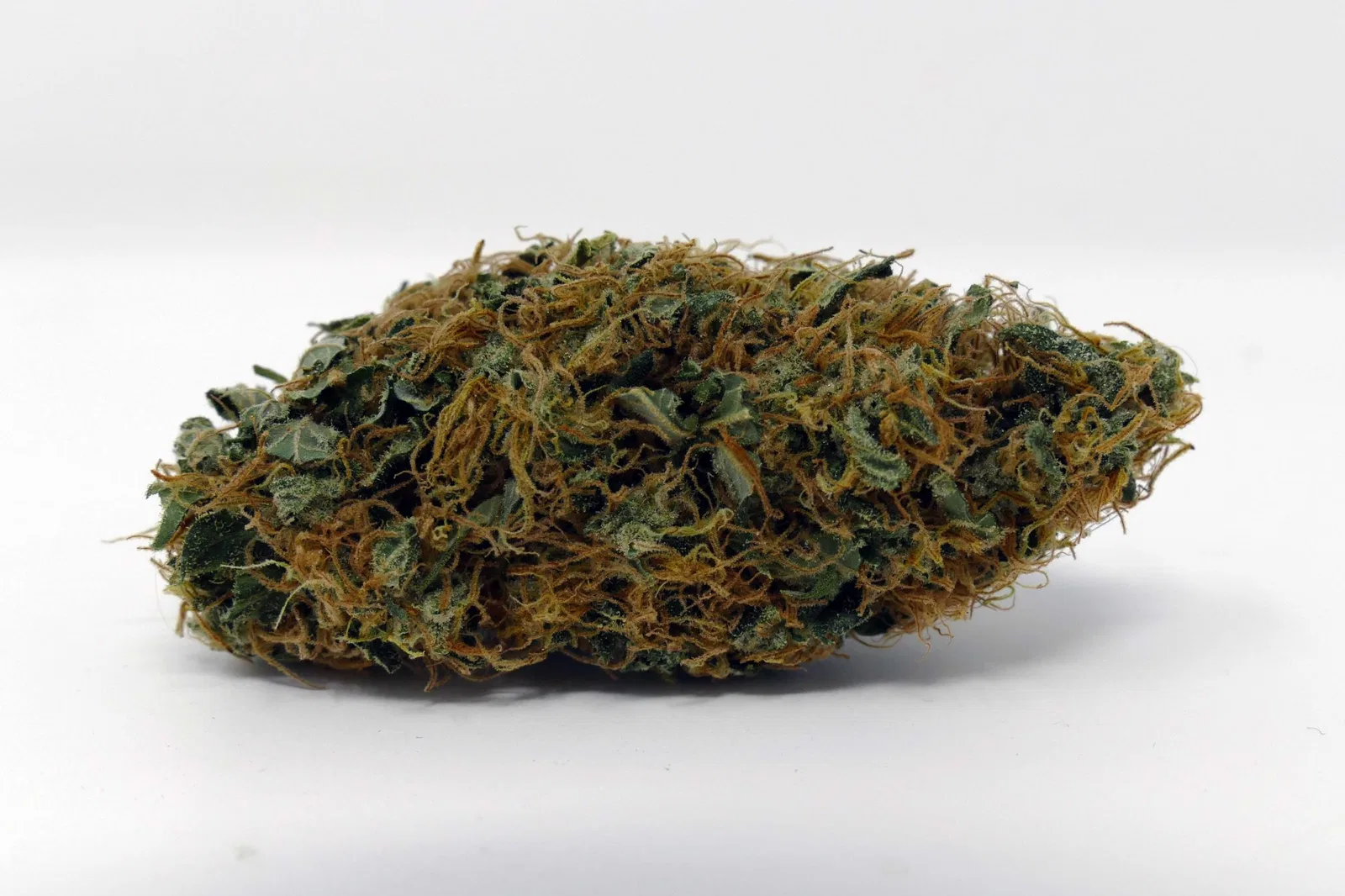
White Widow produces chunky, conical buds with a medium-density structure and a loose, fluffy character. The strain is renowned for its exceptional resin production, with buds appearing completely frosted in white crystal trichomes. The colouration ranges from light to medium green, often with golden pistils woven throughout the flower. The heavy trichome coverage gives the buds a sticky texture and a glistening, almost white appearance under light, which is the origin of the strain's name.
Aroma
White Widow presents a complex aromatic profile dominated by earthy, woody, and spicy notes. The initial scent upon opening a container is often described as dank and pungent, with underlying pine and herbal characteristics. When broken apart, the buds release sharper spicy and peppery notes. The aroma carries a classic old-school cannabis character that many long-term consumers associate with the golden era of Dutch coffee shop genetics.
Flavour
Reported flavour notes include woody, earthy and spicy.
Reported character
Reported effects include euphoric, uplifted, creative, talkative and energetic. Individual experiences vary.
Cannabinoids and terpenes
White Widow typically tests between 18% and 25% THC, with CBD around 1% and trace amounts of CBG. The dominant terpenes are Myrcene, Caryophyllene, and Pinene, contributing to the strain's earthy, spicy, and piney character. Myrcene may contribute to the relaxing body effects, while Pinene adds a sharp pine freshness and Caryophyllene provides the peppery, spicy notes detectable on the palate.
Cultivation
White Widow is considered a moderately easy strain to cultivate and is well-suited to both indoor and outdoor growing environments. Indoor flowering time averages 8 to 9 weeks, with yields ranging from 400 to 600 grams per square metre under optimal conditions. Outdoor plants can reach substantial sizes and produce up to 900 grams per plant, with harvest ready by early October in the Northern Hemisphere. The strain shows good resistance to mould and performs well with training techniques including Sea of Green (SOG) and Screen of Green (SCROG). Reducing the light cycle to 8 hours during the final two weeks of flowering is sometimes recommended to enhance resin production. Moderate feeding is advised, as the strain can be sensitive to overwatering and excess nutrients.
Cultivation information is educational. Growing cannabis is permitted only in certain markets — check your local laws.
Phenotypes and variation
Multiple phenotypes of White Widow exist across different seed banks and breeders. The original Green House Seeds version is the most famous, but versions from other breeders including Dutch Passion, Royal Queen Seeds, and Seedsman have established their own reputations. Phenotypic variation can produce expressions leaning more towards the Brazilian sativa side (taller, longer flowering, more energetic effects) or the South Indian indica side (shorter, faster flowering, more body relaxation).
Background
White Widow is one of the most legendary cannabis strains ever bred, with a history stretching back to the late 1980s in the Netherlands. First created by Ingemar (also known by the seed bank name De Sjamaan) under the original name Arnhem's Wonder, this cross of a Brazilian sativa landrace and a resin-heavy South Indian indica won the first High Life Cup in 1989. In 1992, Arjan of Green House Seeds purchased the original male and female plants and re-released the cross as White Widow in 1994, going on to win 1st prize at the Bio High Times Cannabis Cup in 1995. The name White Widow comes from the strain's extraordinary resin production, with buds appearing completely blanketed in white crystal trichomes.
In the UK, White Widow became a staple of the coffee shop tourism era of the 1990s and 2000s, with British visitors to Amsterdam regularly seeking it out. Its fame was further amplified by references in popular culture, including the TV series Weeds and numerous rap lyrics. The strain's reputation for delivering a powerful combination of euphoric sativa energy and relaxing indica body effects made it a benchmark against which many subsequent hybrids were measured. White Widow remains one of the most searched-for cannabis strains by UK consumers, with an estimated 8,100 monthly searches in the UK alone.
The strain typically produces chunky, conical buds with a loose and fluffy structure that nonetheless pack incredible density and resin coverage. White Widow is noted for its resistance to mould, making it a practical choice for both indoor and outdoor cultivation. The flowering time averages 8 to 9 weeks indoors, with outdoor harvests ready by early October in the Northern Hemisphere. Despite the emergence of newer, more potent cultivars, White Widow's balanced high and historical significance ensure it remains relevant to new generations of cannabis consumers.
Awards and reputation
White Widow won 1st prize at the Bio High Times Cannabis Cup in 1995 under Green House Seeds. Its earlier incarnation as Arnhem's Wonder won the High Life Cup in 1989. White Widow remains one of the best-known cannabis cultivar names and is frequently referenced in music, television and film.
Uncertainty and variation
White Widow appears under several names in the archive. Cultivar characteristics vary between growers and batches. The archive records a specific reviewed sample — it is not a current product specification.
Reported Effects of White Widow
Users most commonly report feeling euphoric, uplifted, creative, talkative and energetic after consuming White Widow. These subjective effects are drawn from user-reported data and individual experiences vary considerably. The effects profile is influenced by the strain's dominant terpenes — Myrcene (aroma and mood), Caryophyllene (comfort and ease), and Pinene (freshness and energy) — as well as individual tolerance, consumption method and dosage.
Terpene Profile
The dominant terpenes recorded for White Widow are Myrcene (an earthy, musky profile commonly associated with relaxation and the classic sedative sensation), Caryophyllene (a spicy, peppery character associated with comfort and ease) and Pinene (a sharp pine aroma linked to alertness and mental clarity). Terpene profiles can vary between phenotypes, growing conditions and curing methods.
For more on how terpenes influence the cannabis experience, see our guide to cannabis terpenes and browse the terpene directory.
Flowering Time and Cultivation
White Widow has a typical indoor flowering time of approximately 8 to 9 weeks. Outdoor growers in the Northern Hemisphere can expect harvest around early October. The cultivar is known for compact indica-leaning structure, heavy trichome production giving buds a frosted appearance, and reliable yields.
Cultivation information is provided for reference. Growing conditions, phenotype selection and cultivation skill materially affect outcomes.
White Widow Questions
What did the White Widow review say about its background?
First created by Ingemar (also known by the seed bank name De Sjamaan) under the original name Arnhem's Wonder, this cross of a Brazilian sativa landrace and a resin-heavy South Indian indica won the first High Life Cup in 1989.
How strong is White Widow?
The archive record notes THC 15% and CBD <1% for White Widow. Actual potency varies between batches, growers and phenotypes.
Is White Widow suitable for beginners?
Some consumers report feeling paranoid or anxious with White Widow, so beginners should start with a very small amount and give it time before consuming more. Individual tolerance varies considerably.
Is White Widow indica or sativa?
White Widow is recorded as hybrid. Most modern cultivars are hybrids with both indica and sativa ancestry, so individual experiences can vary.
What terpenes are found in White Widow?
The archive records myrcene, caryophyllene and pinene as terpenes associated with White Widow.
What are the potential downsides of White Widow?
Commonly reported side effects include dry mouth, dry eyes and dizzy. These are self-reported and vary widely between consumers.
Is every White Widow sample identical?
No. Phenotype, cultivation methods, storage conditions and batch differences can materially change appearance, aroma, flavour and reported character. The archive records what was observed in specific samples — your experience may differ.
Why is it called White Widow?
The name comes from the strain's extraordinary resin production — buds are so thickly coated in white crystal trichomes that they appear dusted in sugar. First created by Ingemar (De Sjamaan) under the original name Arnhem's Wonder.
What awards has White Widow won?
White Widow won the 1995 Bio High Times Cannabis Cup and the 1989 High Life Cup, establishing itself as one of the most decorated Dutch-bred cultivars of the 1990s coffee shop era.